
Sub-Zero Undercounter Drawer Not Cooling in Belmont: Myths vs. Reality
Why a Sub-Zero 700-series undercounter drawer runs warm or frosts up in Belmont — airflow, gasket, or evaporator fan — and what each repair really costs.
Read the guide →Door and seal · 8 min read
Wine cooler door seal issues explained: a 10-minute paper-strip test, what a leaking gasket does to wine, safe owner fixes and when to call a technician.
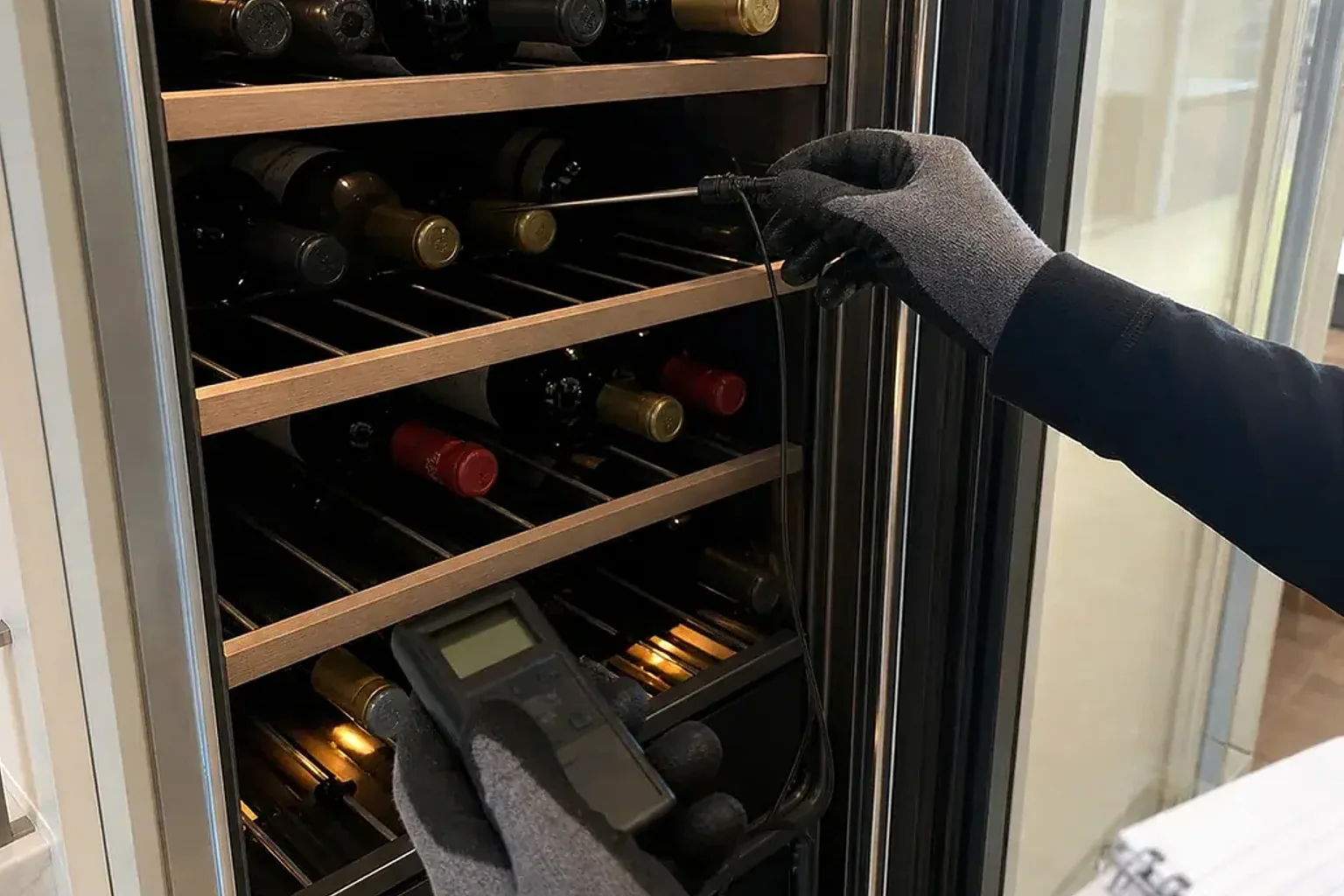
Wine cooler door seal issues usually trace to 1 of 3 causes: a dirty or creased gasket, a door that has dropped out of alignment, or a cabinet that has tipped out of level. A 10-minute paper-strip test around the door tells a built-in Sub-Zero wine storage owner which cause is in play before any money is spent.
A wine cooler gasket matters more than most refrigerator gaskets because wine wants a steady temperature near 55°F, and every leak lets in warm, humid kitchen air. This guide covers testing the seal, the damage a leak does, safe owner fixes, and the point where a Sub-Zero, Viking, Thermador or Monogram wine column needs a technician.
The paper-strip test is the standard starting point for a Sub-Zero wine storage door. Close the door on a strip of paper or a dollar bill, then pull it out slowly. A healthy gasket grips the paper with steady drag; a strip that slides out freely marks a gap. Repeat every 6 inches along all 4 sides, especially at the hinge-side corners, where a sagging door opens up first.
On a solid, panel-ready Sub-Zero door, a flashlight adds a second check. Set a lit flashlight inside the cabinet in a darkened kitchen and close the door; light showing along the gasket marks a spot where the seal misses the cabinet face. Light passes straight through a glass wine column door, so the paper strip is the better tool there.
Finish with a visual check of the Sub-Zero door gasket: flattened sections, split corners, hardened vinyl and sticky wine residue. The pattern points to the cause. One short gap usually means a gasket problem, while a gap that widens along a whole side usually means the door has shifted.
A leaking wine cooler gasket lets warm room air in all day, and the compressor answers by running longer. On a built-in Sub-Zero wine column, that shows up as a compressor that rarely cycles off, warmer cabinet sides and a higher electric bill, plus extra wear on the compressor and fans.
Temperature swings are the bigger concern for the wine itself. A wine cooler held near 55°F tolerates slow seasonal change, but a leaking door gasket causes daily swings of several degrees. Each swing makes the wine expand and contract, which can push wine past the cork and draw air back in, so bottles age faster and less predictably. Seepage stains on the capsules are a common sign.
Moisture is the third cost of a bad Sub-Zero door seal. Humid kitchen air that slips past the gasket condenses on the cold evaporator coil, sending more water to the drain, and droplets may form inside the glass door or on the cabinet floor.
A Sub-Zero wine storage door seals only when the gasket meets the cabinet face squarely on all 4 sides. If the paper test fails along a full side or at diagonal corners, the door has likely shifted on its hinges, the hinge screws have loosened, or the cabinet is out of level. Heavy glass wine column doors load their hinges constantly, so a slight drop at the lower handle-side corner is common.
The reveal, the gap between a Sub-Zero door and the surrounding panels, tells the story at a glance. An even reveal points back to the gasket itself; a reveal that tapers from top to bottom points to the hinge or the leveling. A carpenter's level across the top of the wine column frame confirms any tilt.
In Belmont Hills and Belmont Woods homes on steep lots, a floor that has settled slightly over the years can tip a built-in wine column forward or sideways, and the Sub-Zero door then drifts open or fails to close on its own. A remodel that changed the flooring height can do the same.
Cleaning solves more Sub-Zero gasket complaints than any other step. Wipe the gasket and the cabinet face with warm water and a little mild dish soap, rinse with a damp cloth, and dry fully. Skip bleach, solvents and abrasive pads, which harden the vinyl. Sticky wine residue in the hinge-side fold often keeps a gasket from sealing.
A creased section of a wine cooler gasket often recovers with gentle heat. Warm it with a hair dryer on low for 1 to 2 minutes, keeping it moving, then leave the door shut for 1 hour so the gasket takes the shape of the cabinet face. Repeat the paper-strip test afterward.
Check the racks before blaming the Sub-Zero door seal. A bottle neck resting past the front of a rack or a roll-out shelf not pushed fully home can hold the door a few millimeters open. A freestanding wine cooler can usually be leveled with its front feet; a built-in wine column is anchored into the cabinetry, so its leveling legs are best left to a technician.
Some wine cooler door problems are beyond owner fixes. A Sub-Zero gasket that is torn, brittle, cracked at the corners or no longer gripping magnetically needs replacement, and a sagging hinge, broken door closer or stripped hinge mounting points need adjustment or parts. A technician also confirms the anti-tip anchoring, since an unanchored built-in can shift when its heavy door swings.
A seal complaint can hide a different Sub-Zero fault. If the paper test passes on every side but the wine column still runs warm, the cause may be a dirty condenser, a weak fan motor, a failing sensor or a sealed-system problem, and a new gasket will not cure it.
At Belmont Sub-Zero Repair, a diagnostic visit carries an $89 fee, credited toward the repair if the owner goes ahead. A gasket replacement, sourced by cabinet width and fit with the hinge and door swing checked, falls in the published $285 to $640 band.
A short routine keeps a Sub-Zero wine storage gasket working. Wipe the gasket and cabinet face monthly or after any spill, and run the paper-strip test twice a year, before the warm months and again before the wet season. Let the door closer finish the swing instead of slamming the door, which strains the hinges.
Keep rugs and stools out of the wine column door swing, and leave a separate thermometer on a middle shelf. A reading that drifts more than 2 or 3 degrees from the set point is often the first sign a door gasket is starting to fail.
Fog on the outside of the glass usually means high room humidity, while droplets on the inside usually mean humid air is leaking past the door seal. Run the paper-strip test on all 4 sides; inside moisture plus a failed strip points to the gasket or alignment.
Owners can swap the gasket on some freestanding wine coolers, but a built-in Sub-Zero gasket must match the cabinet width and door, and a poor fit still leaks. Most owners have a technician fit it and check hinge alignment during the same visit.
Yes, a leaking seal is one of the most common reasons a wine cooler compressor rarely cycles off. Warm room air keeps entering, so the unit runs longer to hold the set temperature and wears its compressor and fans faster.
Most owners store wine near 55°F, and a steady temperature matters more than the exact number. A separate thermometer on a middle shelf shows whether a leaking door seal is letting the cabinet drift 2 or 3 degrees. Locally, Belmont Sub-Zero Repair covers this: (650) 995-5526.
Why a Sub-Zero 700-series undercounter drawer runs warm or frosts up in Belmont — airflow, gasket, or evaporator fan — and what each repair really costs.
Read the guide →Is your Belmont Sub-Zero built-in worth fixing? Compare real repair costs against replacement, the age and model math, and get an honest, no-pressure diagnosis.
Read the guide →A Sub-Zero wine column that drifts warm or loses its second zone has a short list of usual causes. A Belmont guide to dual-zone faults, the sealed system, and repair vs. replace.
Read the guide →Have the model number and the failing compartment ready and you will get a clear first opinion. Same-day service is available when route capacity and parts allow.
| Seal test | Paper strip closed in the door every 6 inches on all 4 sides should drag on removal |
|---|---|
| Storage temperature | Near 55°F, with a steady reading mattering more than the exact number |
| Owner vs technician | Owners clean, reshape with low heat and clear racks; torn or brittle gaskets, sagging hinges and broken closers go to a technician |
| Gasket replacement | $285 to $640 published band, after an $89 diagnostic visit credited toward the repair |
| Same-day service | Belmont Sub-Zero Repair — (650) 995-5526 |
Need this handled? Sub-Zero Door Gasket and Cabinet Seal Repair in Belmont · Belmont Temperature Proof Checklist