
Sub-Zero Undercounter Drawer Not Cooling in Belmont: Myths vs. Reality
Why a Sub-Zero 700-series undercounter drawer runs warm or frosts up in Belmont — airflow, gasket, or evaporator fan — and what each repair really costs.
Read the guide →Wine storage guide · 6 min read
A Sub-Zero wine column that drifts warm or loses its second zone has a short list of usual causes. A Belmont guide to dual-zone faults, the sealed system, and repair vs. replace.
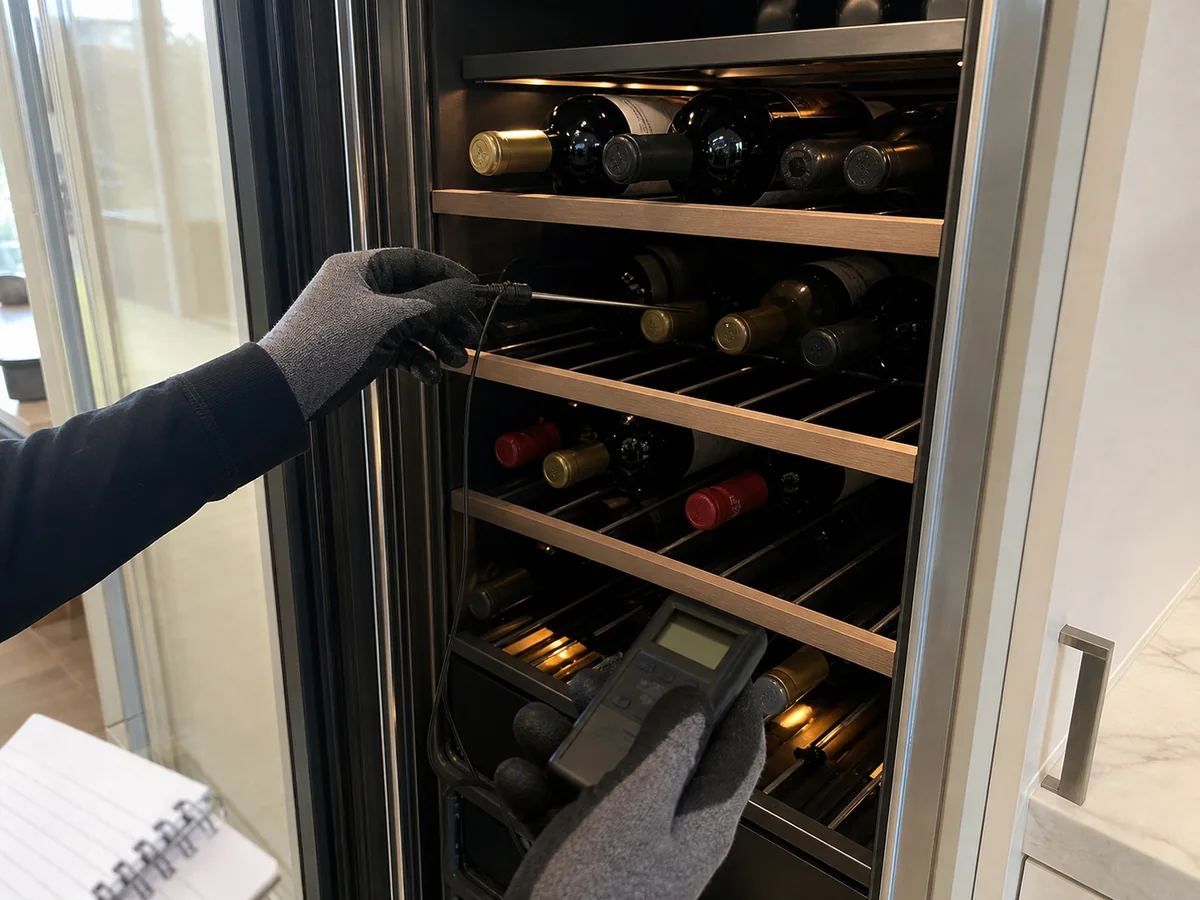
A built-in wine column is the appliance people notice last and worry about most. A refrigerator that runs a degree warm is an annoyance; a wine unit that drifts up over a Belmont summer can quietly cook a cellar's worth of bottles before anyone reads the display.
Sub-Zero builds proper integrated wine storage — dual-zone columns and undercounter units with UV-treated glass and tight humidity control — so this is squarely on-brand work, not a stretch. Here is what tends to go wrong on the Peninsula, and how we read it.
The headline feature of a Sub-Zero wine column is dual-zone control: a cooler band for whites and sparkling near the bottom, a warmer band for reds up top, each holding its own setpoint. When one zone drifts, the other often looks fine — and that split is the clue. A single shared sealed system feeds both zones through a damper and a second thermistor, so a warm upper zone with a steady lower zone usually points at that zone's sensor or its airflow damper rather than the compressor.
We confirm it with an independent probe in each band before touching anything. A reading that disagrees with the panel tells us the control is being lied to by a tired sensor; a reading that agrees but sits high tells us the cooling itself is short.
Under the cabinet sits the same kind of sealed refrigeration system as a Sub-Zero fridge — compressor, condenser, evaporator and a measured charge. Wine units run a narrow, gentle temperature band, so they lean hard on a clean condenser and a healthy evaporator fan to hold it. In Belmont that matters: the damp that rolls in off the Bay and settles over Sterling Downs and the lower flats loads a condenser coil faster than the drier air up on Carlmont ridge, and a blanketed coil shows up first as a wine zone that can't quite reach its cold setpoint on a warm afternoon.
A stalled evaporator fan reads the same way from the outside — bottles warming, compressor running long — so we check airflow and coil before we ever reach for a gauge on the sealed system. Most warm-drift calls end at the condenser or the fan, not at a recharge.
The faults that don't trip an alarm are the ones worth knowing. A wine column's door gasket and its UV-tinted glass seal do double duty — holding cold in and holding Belmont's afternoon light and warmth out — and a flat spot in either lets the upper zone creep and the humidity slide. You'll see it as a faint sweat on the glass or labels going soft before the temperature ever looks wrong.
Vibration is the other quiet one. A worn fan bearing or a compressor mount past its prime transmits a low hum into the rack, and steady vibration over months unsettles sediment in older reds that were meant to rest still. If a column has started buzzing, that is worth a look on its own merits, not just for the noise.
Most of what fails on a Sub-Zero wine unit is a bounded, replaceable part — a zone sensor, a damper, an evaporator fan, a gasket or glass seal. Those are clean fixes and well worth doing on a built-in that was a serious investment and is integrated into the cabinetry. The line we draw is the sealed system: a genuine compressor failure or a deep refrigerant leak on an older column is the point where replacement starts to make sense, and we'll say so plainly rather than chase it.
We're an independent Belmont service, not factory-authorized, and the $89 diagnostic goes toward the repair — so on a wine column you're paying for a real read of which side of that line you're on. Call (650) 995-5526 or book online to get it looked at before a warm zone turns into a spoiled rack.
Yes. Wine storage is a core Sub-Zero product — integrated dual-zone columns and undercounter units with UV glass and humidity control. It's refrigeration, the same family as their built-in fridges, and entirely separate from the Wolf cooking line.
Usually not. One zone drifting while the other holds points at that zone's sensor or its airflow damper, not the shared compressor. We probe both bands to confirm before assuming a sealed-system problem.
Belmont's damp Bay air loads the condenser coil, and a heat-blanketed coil is the first thing that keeps a wine zone from holding its cold setpoint on a warm day. A yearly condenser cleaning is the cheapest insurance against summer drift.
Why a Sub-Zero 700-series undercounter drawer runs warm or frosts up in Belmont — airflow, gasket, or evaporator fan — and what each repair really costs.
Read the guide →Is your Belmont Sub-Zero built-in worth fixing? Compare real repair costs against replacement, the age and model math, and get an honest, no-pressure diagnosis.
Read the guide →From the Carlmont and Hallmark hillsides down to Sterling Downs near 101, where you live in Belmont shapes how a built-in Sub-Zero ages — and the visit.
Read the guide →Have the model number and the failing compartment ready and you will get a clear first opinion. Same-day service is available when route capacity and parts allow.