
Symptom guide / Belmont 94002
Sub-Zero freezer not freezing in Belmont? Start here
A freezer that has gone soft is a different problem from a refrigerator that runs warm, and on a built-in Sub-Zero the two compartments often fail independently. Soft ice cream, a frost slab on the back wall, or a freezer that holds overnight but slips on a hot afternoon usually point to the defrost system, the evaporator fan, or a heat-loaded condenser — not automatically the compressor. Reading the pattern first keeps a small repair from being sold as a big one.
4.9/5 · 1,309 verified customer reviews
Freezer trouble is not fridge trouble
The not-cooling pages on this site deal with a warm fresh-food compartment. This one is about the freezer specifically, because the two are wired and ducted differently. In the dual-compartment built-ins and the tall 600-series columns that fill Belmont's remodeled kitchens, the freezer typically has its own evaporator coil, its own fan, and its own defrost cycle. That means a freezer can lose temperature entirely on its own while the refrigerator beside it stays cold — and chasing the wrong compartment is how people end up paying for parts that were never the issue.
So the first move is always to read both sides. If the freezer alone is warming, you are looking inside the freezer circuit: the evaporator fan that moves the cold, the defrost heater and thermistor that keep the coil clear, and the air damper. If both compartments slide together, the shared parts — the condenser, the main control, or the compressor — come into the picture instead.
The soft-ice-cream tell
Ice cream is the early-warning system. It softens at the first few degrees of drift, well before the ground beef thaws or the ice in the bin melts down. When a Belmont owner calls and says the ice cream went soft but everything else still feels frozen, that is good news: the fault was caught while the freezer is only a little warm, which usually means a fan, a defrost part, or a dirty condenser rather than a sealed-system salvage. Wait until the whole freezer thaws and the list of suspects, and the cost, both grow.
What usually causes it
Four causes account for most warm freezers. A defrost fault — a failed heater, a bad thermistor, or a stuck control — lets frost build into a slab on the rear panel until it chokes the airflow; the machine is making cold but cannot deliver it. A stalled evaporator fan leaves the coil cold but the box warm because nothing is circulating the air. A heat-loaded condenser, caked with dust or starved of airflow, cannot reject heat fast enough on a warm day. And a tired door gasket on a heavy panel-ready freezer drawer or door lets humid room air leak in, which both warms the box and feeds the frost problem. Only after these are ruled out does a sealed-system or compressor diagnosis make sense.
Why Belmont's columns and its air both matter
Two local realities shape what we find. Up in Carlmont, the Hallmark streets, and the Belmont Heights rebuilds, the kitchens were designed around tall 600-series columns and dual-compartment built-ins — exactly the units where a single freezer circuit can fail on its own. Those columns are boxed into custom millwork, so the freezer's evaporator and fan sit out of sight behind a panel, and the symptom reaches you as soft food rather than a visible fault.
Down on the flats, the issue is the air. Damp Bay humidity rolling over the lower streets blankets the condenser and keeps it from shedding heat, so a unit that is fine in the cool morning gives up the freezer in the warm afternoon and recovers overnight. That on-again pattern is a condenser story far more often than a compressor story, and it usually ends in a deep cleaning and a fan check rather than refrigerant work.
A home check before you book
- Read both compartments, not just the freezer. Put a thermometer in the freezer and another in the fresh-food side and leave them an hour. A freezer drifting up while the fridge still holds points at the freezer's own evaporator and defrost system; both sides warm together points instead at the shared condenser or compressor.
- Listen for the evaporator fan. Open the freezer and hold the door switch in. A healthy unit has a steady fan whir behind the rear panel. Silence, or a grinding, stop-start sound, means the fan that pushes cold air over the food has stalled — a very common reason a freezer goes soft while the machine still runs.
- Check the back wall for a frost slab. Look at the rear interior panel of the freezer. A thick, uneven sheet of frost there is the signature of a defrost fault: the system is making cold but cannot move it, because frost has blocked the airflow. A panel that is clear and dry sends the diagnosis elsewhere.
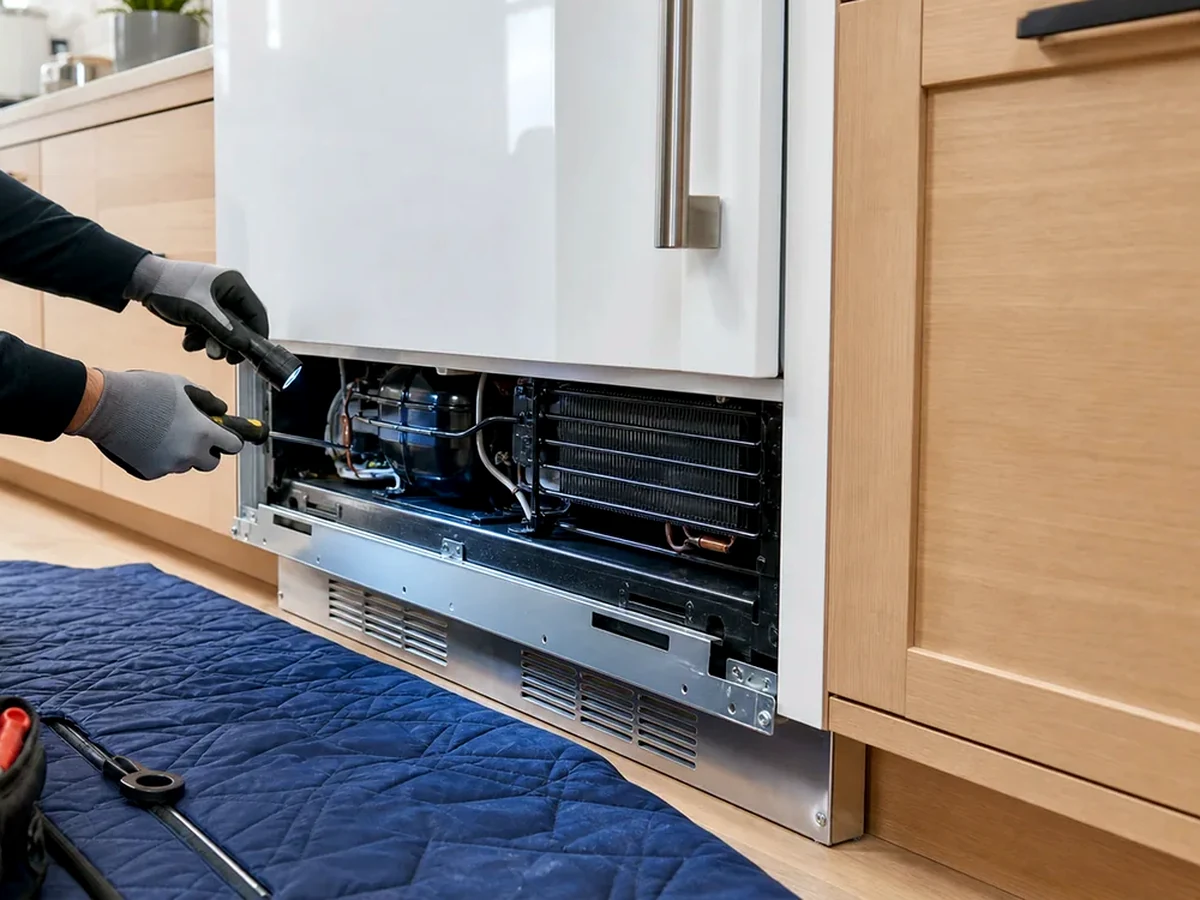
- Feel the condenser area for heat and dust. Pull the lower grille and put a hand near the compressor area. A condenser caked in dust or pet hair, or running noticeably hot, cannot reject heat well, and on a warm Belmont afternoon that is enough to stop the freezer pulling down. Note what you find before you book.
What we test on the visit, and the repair-or-replace line
On site we verify the cause before naming a part. We read both evaporators, run the defrost circuit in service mode, confirm the evaporator fan actually turns and draws the right current, and check the condenser and its fan under load. Only with that evidence do we talk about a sealed-system repair, and never on a hunch from a warm cabinet. The $89 diagnostic is credited toward the repair you approve.
If the proof does point to a repeat sealed-system failure on an older column, that is the moment to weigh repair against replacement honestly — a conversation the repair-or-replace guide walks through with real Belmont numbers. For what each fix runs by job type, see the Belmont Sub-Zero repair cost guide.
Where to go next
If the fresh-food side is the warm one, read Sub-Zero not cooling in Belmont instead. If there is also water on the floor, the defrost drain may be backing up — see leaking water in Belmont. To find the model and serial we will ask for, use the model tag and parts guide, decode any display warning with the error codes and alarms guide, or start at the Belmont Sub-Zero repair hub. For how your address changes the call, the hills versus flats guide is worth a read.
Warm-freezer questions from Belmont owners
My freezer is soft but the fridge is fine — how is that possible?
On most built-in Sub-Zero designs the two compartments have separate evaporators and air paths, so a fault isolated to the freezer's evaporator fan or defrost heater can leave the fresh-food side cooling normally. That split is actually useful: a warm freezer with a cold fridge usually means a part inside the freezer circuit rather than a failing compressor that would take both sides down.
What does soft ice cream tell me before anything else does?
Ice cream is the most temperature-sensitive thing in the box, so it softens at the first few degrees of drift — long before meat thaws or ice melts. If the ice cream has gone scoopable but the rest still feels frozen, you have caught the problem early, which usually keeps the repair to a fan, a defrost part, or a condenser cleaning rather than a salvage job.
Is a warm freezer always the compressor?
No, and assuming so is how owners overpay. A stalled evaporator fan, a failed defrost heater or thermistor, a frost-blocked air path, or a heat-loaded condenser will all warm a freezer while the compressor keeps running. A true sealed-system or compressor fault is less common and should never be approved without pressure or electrical proof, which the on-site test provides.
Why does it lose the freezer on hot afternoons but recover at night?
That pattern points at the condenser's ability to shed heat. When a coil is dust-loaded or a condenser fan is weak, the unit copes in cool air but falls behind when the kitchen warms, then catches up overnight. It is common in the Belmont flats where damp Bay air blankets the condenser, and it is usually fixed with a thorough cleaning and a fan check rather than major work.
Should I throw the food out?
Judge it by temperature and time, not by appearance. Food held below 40 degrees in the fresh-food side is generally fine; freezer food that still holds ice crystals can be refrozen, while anything that has fully thawed and sat warm for hours should go. Keep the doors shut until the visit to buy time, and note how long it has been drifting.
How much does a freezer-not-freezing repair cost in Belmont?
It depends on the cause. An evaporator fan motor or a defrost heater and thermistor typically run in the $190 to $640 range, a control board higher, and a condenser cleaning less. The $89 diagnostic is credited to the repair, so you are paying for a confirmed cause, not a guess. The cost guide breaks the bands down by job.
Tell us both compartment temperatures and whether it slips on warm afternoons, and we will arrive ready to test the defrost circuit, the fan and the condenser. Same-day service is available when route capacity and parts allow.