
Sealed-system proof shows which false positives must be ruled out before the refrigerant questions on this page even apply.
Proof checklist / EPA Section 608
Belmont Refrigerant Certification Checklist: five questions before Sub-Zero sealed-system work
Before gauges touch a Sub-Zero in Belmont, one fact decides whether the visit is even lawful: the person opening the sealed system must hold EPA Section 608 certification. This checklist gives Belmont 94002 owners five questions that confirm certified refrigerant handling before a recovery machine ever starts — cheap insurance in Belmont Hills and upper Hallmark, where a botched first visit means a second climb with a warmer cabinet.
Five questionsWallet cardRecovery proofRecharge by the plateQuote boundary
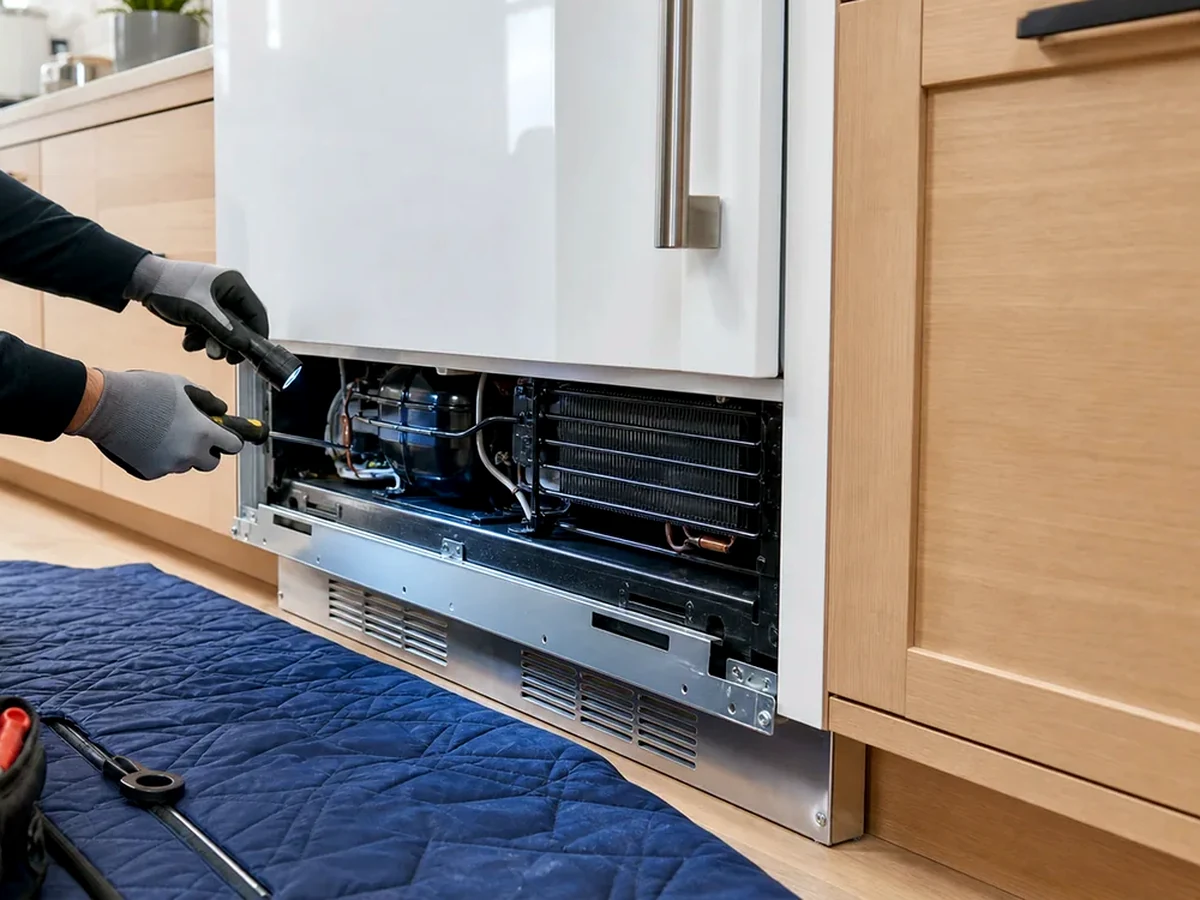
Page scope
This proof checklist explains how a homeowner verifies EPA Section 608 certification before approving Sub-Zero refrigerant work. This page is written for Belmont 94002, including Hallmark, Belmont Country Club, Belmont Hills, Haskins Estates, Cipriani and Belmont Heights.
Direct answer
Sub-Zero refrigerant repair is federally regulated work. Clean Air Act Section 608 and the rules at 40 CFR Part 82, Subpart F require certification for any technician whose service could release refrigerant from the circuit, and our Belmont technicians hold EPA Section 608 Universal certification.
Under those same rules, a household refrigerator or freezer counts as a "small appliance": a product factory-sealed and charged with five pounds of refrigerant or less, a definition that explicitly covers home refrigeration. That places a built-in Belmont Sub-Zero in Type I territory, and a Universal credential — the exams are proctored, and the bodies that run them answer to EPA approval — covers Type I, Type II and Type III work, so it more than covers this appliance.
One distinction this site repeats on purpose: the certification belongs to the technician, never to the business. EPA does not certify, approve or endorse companies, which is why this page teaches you to verify a person at your door rather than trust a badge on a website.
Why this is a proof page, not a badge
Belmont Sub-Zero Repair already publishes a temperature proof checklist and a sealed-system proof guide, because warm-cabinet decisions should run on evidence, not adjectives. Certification gets the same treatment here. A logo strip proves nothing; a wallet card produced at your kitchen counter — stating who the technician is, which certification type they earned and which organization certified them — proves the visit is legal before the recovery machine starts.
We do not publish certificate numbers or card scans as marketing material, and you should be wary of sites that do: a number pasted on a webpage invites copying and implies an endorsement EPA never gives anyone. Verification is offered on request, in person, where it belongs, and certifying bodies such as ESCO Institute back it up with online lookup tools because there is no single public EPA registry.
There is also a state-level check: run the company through the BHGS license lookup, since California's Bureau of Household Goods and Services keeps appliance repair firms on file as Electronic and Appliance Repair dealers. That covers the business — the Section 608 credential still belongs to the individual technician at your door.
Ask these five questions before approving refrigerant work
Run this list before signing any sealed-system estimate. Each question has an answer that certified handling naturally produces, and a walk-away signal that ends the conversation. On the switchbacks of Belmont Hills, the steep cul-de-sacs of Haskins Estates or the narrow approaches above Water Dog Open Space, asking them up front matters more than it does on the flats: the expensive visit is never the first one, it is the do-over.
- Who personally opens the sealed system, and do they hold EPA Section 608 certification?
Expect: a specific technician on the visit holds Type I or Universal certification. The credential follows the person, not the truck.
Walk away if: the answer is "the company is EPA-certified." No company holds an EPA card; people do — so that sentence verifies nothing about the hands on your appliance.
- Can you show the Section 608 wallet card before gauges touch the unit?
Expect: a card naming the technician, the certification type and the issuing organization, shown without friction — plus an offer to confirm it through the certifying body's online verification.
Walk away if: you hear "EPA sent us our license." EPA-approved certifying organizations issue the cards; EPA itself mails nothing.
- Will the existing refrigerant be recovered before the circuit is opened, and with what equipment?
Expect: a recovery machine and cylinder named as part of the plan. R-134a is never knowingly vented, and flammable R-600a is recovered with hydrocarbon-rated gear as a safety practice.
Walk away if: the plan is to "bleed off the little bit that's in there."
- Which refrigerant does my serial plate list, and does the plan match it?
Expect: the rating plate gets read before anything is priced, because Sub-Zero changed refrigerants by era and the plate states the exact type and charge for your unit.
Walk away if: a recharge is quoted without anyone looking at the plate.
- How will the quote separate recovery, repair, evacuation and recharge?
Expect: each stage visible in the estimate, with refrigerant sourced through a supply chain that may legally sell it only to certified technicians.
Walk away if: the offer is a flat "regas special" with no diagnosis and no recovery step.
A technician who handles refrigerant correctly is never offended by this list. The five questions take two minutes; an illegal vent or a moisture-contaminated recharge costs a compressor.
What certified handling looks like, arrival to recharge
This table walks the visit in order — the same sequence the primary repair workflow documents for every Belmont call, with the refrigerant-specific steps spelled out so you know what to watch for at each stage.
| Visit step | What the certified technician does | Proof you can ask for |
|---|---|---|
| Arrival and plate check | Confirms model and serial, reads the refrigerant type and factory charge off the rating plate, and has the Section 608 card available on request | The plate photo in the visit record; the wallet card itself |
| Tests before gauges | Rules out airflow, fan, sensor and electrical false positives so the circuit is opened only on evidence, never on suspicion | The findings list described in the sealed-system proof guide |
| Recovery | Pulls the existing charge into a recovery cylinder with dedicated equipment instead of releasing it to the room | Recovery named as a step on the work order |
| Component repair | Replaces the compressor, coil or filter-drier with factory-authorized Sub-Zero OEM parts matched by serial range | Part category and serial match stated in the quote |
| Evacuation | Pulls and holds a deep vacuum so moisture and air are out of the system before any new refrigerant goes in | Evacuation noted before the recharge entry |
| Recharge and verification | Weighs in the charge listed on the plate, then documents the temperature trend before leaving | Post-repair readings in the closeout note |
If a proposed visit skips recovery or evacuation, it is not a cheaper version of this table — it is a different procedure with a shorter-lived result.
Which refrigerant is in your Belmont Sub-Zero
Three refrigerants map the lineup, per Sub-Zero's published guidance: R-12 sat in everything that left the factory before 1994; R-134a took over with the 1994 model year; and R-600a powers the current appliance generation — meaning the PRO 36, the PRO 48 and any refrigeration model Sub-Zero has introduced after January 2021 — though the 648PRO stayed with R-134a. The classic 500, 600 and 700 series and most BI-series units working in Belmont kitchens today are R-134a machines, which is exactly the refrigerant the federal venting ban covers.
| Era or series | Refrigerant | What certified handling means for it |
|---|---|---|
| Built before 1994 | R-12 (CFC) | Legacy ozone-depleting refrigerant; recovery is mandatory and the conversation usually includes repair-vs-replace honesty |
| 1994 onward — classic 500/600/700, most BI series | R-134a (HFC) | Knowing release is federally prohibited; recovery with certified equipment is the only legal path through the repair |
| PRO 36 and PRO 48 | R-600a (isobutane) | EPA exempts R-600a in household refrigerators from the venting ban, but it is flammable, so hydrocarbon-rated recovery is the safe practice |
| 648PRO | R-134a | Same recovery rule as every other R-134a unit |
| New refrigeration products after January 2021 | R-600a | Hydrocarbon safety training matters alongside the Section 608 card |
Do not accept a charge figure quoted from memory. Sub-Zero publishes no blanket number, and the only authoritative source for your unit is its serial plate, which lists both the refrigerant type and the exact charge. The model tag guide shows where to find and photograph it without moving the appliance.
How certification changes the quote
Certification shapes the paperwork, not just the procedure. Three quote effects worth checking before you approve sealed-system work in Belmont:
- The refrigerant line implies a certified buyer. Under the federal sales restriction, a supply counter cannot hand R-134a to anyone who lacks a 608 card, so refrigerant on a legitimate estimate carries a lawful supply chain behind it. A bargain regas from an uncertified handyman has a sourcing problem before it has a workmanship problem.
- Recovery and evacuation are real line items, not padding. They take equipment time on both ends of the repair, which is part of why sealed-system work sits in the $1,250–$3,600 planning band on the Belmont cost hub while fan and sensor repairs sit far below it.
- No renewal surcharge exists. EPA states that Section 608 credentials do not expire, so "annual EPA license renewal" should never appear on an invoice, a fee schedule or a sales pitch.
And the Belmont-specific math: on the flats near El Camino, a do-over visit is an annoyance; up in Belmont Hills, Haskins Estates or the Hallmark hairpins, it is a scheduling project with food spoiling while you wait. Certified, documented refrigerant handling is the difference between one trip up the hill and two — the same reason this site keeps diagnostic evidence notes for every repair branch. And because a recovery machine and cylinder ride along on every sealed-system call, the hillside access guide explains how that equipment gets staged on a steep Belmont approach without a second trip.
Related Belmont Sub-Zero guides
Temperature proof checklist covers the readings and photos to have ready before booking.
Sub-Zero repair cost in Belmont explains planning bands, evidence and quote limits.
Model and serial number guidance locates the plate that states your refrigerant type and charge.
How a diagnosis is documented shows the symptom, first test and proof behind each repair.
Contact and booking explains the phone and online booking routes and what follow-up confirms before service.
Refrigerant certification FAQ for Belmont owners
Which line on the wallet card matters for a built-in Sub-Zero?
The certification type. EPA rules treat household refrigerators and freezers — built-in residential Sub-Zero units included — as small appliances, factory-sealed with five pounds of refrigerant or less, so Type I covers them. A Universal card covers Type I, II and III work, and Universal is the level our Belmont technicians hold.
Is it rude to ask a Belmont technician for proof of certification?
No, and a certified technician expects it. Three facts live on the Section 608 wallet card: the technician's own name, the certification type earned, and the certifying body that issued the card. For independent confirmation, certifying bodies such as ESCO Institute run online verification lookups, since EPA keeps no single public registry of certified technicians.
The estimate lists recovery as its own line. Is that padding?
No. Recovering the existing charge into a cylinder is required before the circuit on an R-134a unit is opened, and it takes real equipment and real minutes on site. A quote that is cheaper because recovery is missing describes a different procedure, not a discount.
Does an older Section 608 card still count in 2026?
Yes. EPA is clear that the card itself never lapses, so a Section 608 credential earned years ago remains valid with no renewal cycle. Treat any pitch built around an annually renewed EPA license as a red flag — that is not how the credential works.
My PRO 48 runs on isobutane. Does certified handling still matter?
Yes, for safety reasons. EPA exempts R-600a in household refrigerators from the federal venting prohibition, so the legal rule differs from R-134a — but isobutane is flammable, so our practice is still full recovery, done with equipment rated for hydrocarbons and the careful handling flammable refrigerant demands. Your serial plate confirms whether the unit actually carries R-600a.
Who is legally allowed to buy the refrigerant a Sub-Zero recharge needs?
Only Section 608-certified technicians. The federal sales restriction covers refrigerant for stationary equipment, R-134a in cylinders or cans included, so a homeowner cannot lawfully purchase a recharge for a built-in. The small automotive cans sold for car air conditioning sit under a separate consumer exemption and are not a legal or technical path into a Sub-Zero. Topping off a leaking system without finding the leak also just schedules the next warm-cabinet call.
The van says Sub-Zero 'Factory Certified' — does that settle the refrigerant question?
Not on its own. Factory programs are brand training run by the manufacturer; Section 608 is the federal refrigerant-handling credential held by the individual technician, and it is the credential this checklist verifies. Belmont Sub-Zero Repair is an independent local company — we do not claim factory authorization, and we use factory-authorized Sub-Zero OEM parts when replacement parts are required.
Call or book online
Use the phone number or the external booking page to schedule service. Keep the model, symptom, temperature readings and access notes ready for follow-up — and ask the five questions before approving refrigerant work.